From Sample to Container: A About Timeline — Contract Supply Guide
VapeWholesaleHub About · About buyer resources
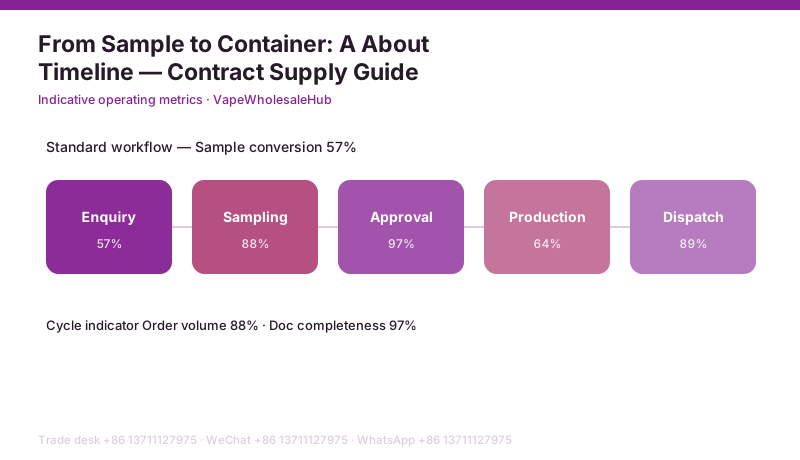
Most conversations about from Sample to Container: A About Timeline — Contract Supply Guide start in the wrong place. Someone asks for a price per unit before anyone has agreed what the unit actually is. This page works through the subject the way a purchasing desk experiences it, from the first sample request to the container arriving at the dock.
Where the supply actually comes from
Sourcing decisions around from Sample to Container: A About Timeline — Contract Supply Guide are usually made on price and then regretted on consistency. The input changes, the tolerance drifts, and suddenly the line that sold through in March behaves differently in July. Locking the input specification in writing is the cheapest insurance a wholesale buyer can buy.
On the sourcing side, from Sample to Container: A About Timeline — Contract Supply Guide comes down to how much of the chain you can see. A trading desk that only ever talks to a sales rep is buying on faith. We prefer accounts that ask for the factory audit, the mixing records and the batch numbers, because that paperwork is what protects everyone when a shipment is questioned later.
Documentation and regulatory reality
Buyers sometimes treat compliance for from Sample to Container: A About Timeline — Contract Supply Guide as a cost to be minimised. It reads better as a moat. When the market tightens, the accounts that already hold complete technical files keep trading while everyone else scrambles to produce paperwork that should have existed a year earlier.
The compliance burden around from Sample to Container: A About Timeline — Contract Supply Guide is mostly about being boring and consistent. Keep one version of the truth for every SKU, stamp the revision date, and make sure the file a regulator sees is the same one your warehouse picks from. Most enforcement cases we have watched started with a mismatch between two internal documents.
What quality control looks like in practice
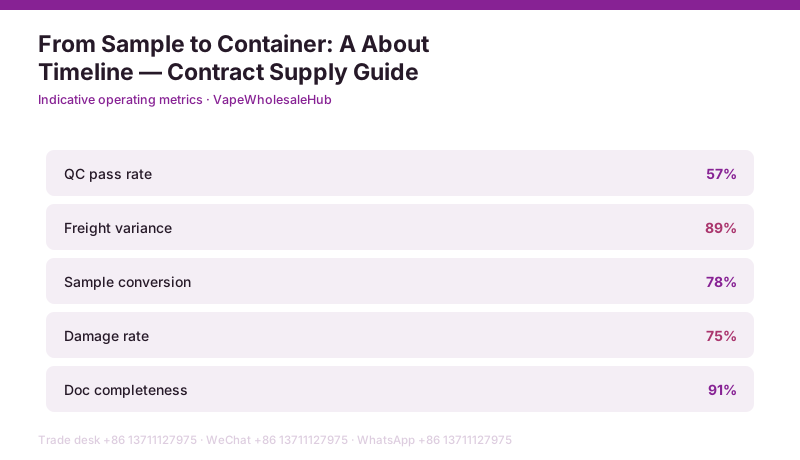
A quality system for from Sample to Container: A About Timeline — Contract Supply Guide should produce a number someone is accountable for. Defect rate per batch, days to resolution, repeat complaint rate. Without a number, quality becomes an opinion, and opinions do not survive a busy quarter.
The failure modes in from Sample to Container: A About Timeline — Contract Supply Guide are predictable once you have seen enough of them. Seals that relax in heat, tolerances that drift after a tooling change, inputs that separate in transit. Testing for the known failure modes catches roughly ninety percent of what would otherwise reach a customer.
Technical detail worth understanding
Specification drift is the quiet risk in from Sample to Container: A About Timeline — Contract Supply Guide. A unit approved in January is not necessarily the unit shipped in September unless the change control is tight. We document every revision, and we tell accounts before the change rather than after someone notices.
The engineering around from Sample to Container: A About Timeline — Contract Supply Guide is mostly about managing heat and airflow. Change either and the whole experience moves. Buyers who understand that relationship can read a spec sheet properly and spot the marketing numbers that do not survive contact with a customer.
Order structure at a glance
| Item | Standard | Volume | Programme |
|---|---|---|---|
| Typical order unit | Master carton | Pallet | Full container |
| Documentation | COA + SDS | COA + SDS + batch record | Full technical file |
| Lead time | 2-4 working days | 5-10 working days | 15-25 working days |
| Customisation | Label only | Label + closure + bottle | Full OEM / ODM |
| Sampling | Charged, credited on order | Included in development | Multi-round approval |
| Indicative MOQ | 600 units | 3,000 units | 12,000 units |
| Development window | n/a | 5-8 working days | 5-8 + approval |
Common questions
What is the usual minimum order quantity?
Minimum order quantity depends on the line. Standard stock items typically start at a single master carton, while custom work, private label artwork and bespoke tooling carry higher thresholds because the setup cost has to be recovered. We publish the figure for each line rather than quoting one blanket number.
How are samples handled?
Sample packs are charged at cost with the shipping borne by the buyer, and the amount is credited against your first bulk order. That keeps sampling serious and avoids the delays that come with an open-ended free sample programme.
How long does a bulk order take to arrive?
Stock lines usually leave the warehouse within two to four working days, with transit depending on the mode you choose. Custom development runs on a longer clock: formulation, approval, production and testing before anything ships. We give a written schedule at order confirmation and flag slippage the day we see it.
Related reading
- About: Building a Reorder Calendar — New Account Setup
- About and after sales support: Notes From the Trade Desk — Regional Depot Guide
- About and buyer onboarding in Contract Supply — New Account Setup
- About Programmes for Independent Retailers — Retail Chain Focus
- About and Category Review Timing — New Account Setup
- About Vape Supply Notes 936
Talk to the wholesale desk. Specifications, MOQ, stock and freight options for from Sample to Container: A About Timeline — Contract Supply Guide.
Phone +86 13711127975 · WeChat +86 13711127975 · WhatsApp +86 13711127975