Understanding record keeping in About Wholesale — Trade Buyer Briefing
VapeWholesaleHub About · About buyer resources
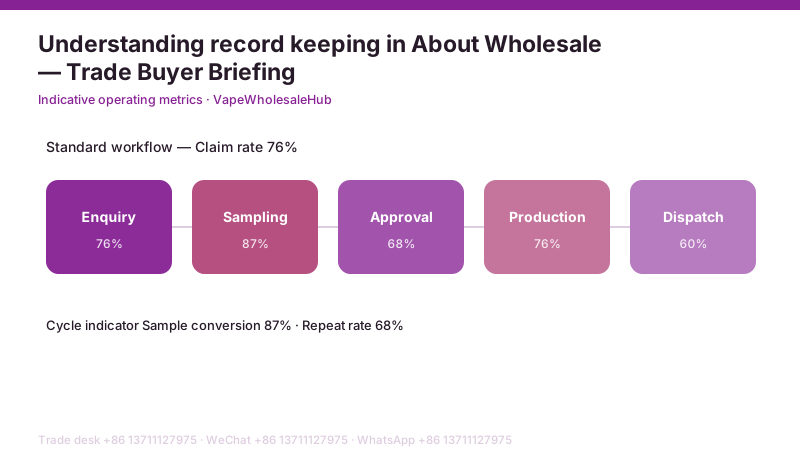
There is a version of understanding record keeping in About Wholesale — Trade Buyer Briefing that exists in supplier decks, and there is the version that shows up on a warehouse floor at 7am when a shipment is short by two cartons. We spend our time in the second version. Below is what we have learned handling understanding record keeping in About Wholesale — Trade Buyer Briefing for wholesale accounts.
The commercial side of the decision
Commercially, understanding record keeping in About Wholesale — Trade Buyer Briefing rewards buyers who think in turns rather than in unit cost. A slightly higher price on a line that sells through twice as fast is better money than a cheap line that occupies shelf space and working capital for two seasons.
The accounts that grow steadily on understanding record keeping in About Wholesale — Trade Buyer Briefing tend to do one boring thing well: they reorder before they run out. It sounds obvious. In practice, most wholesale buyers reorder late, pay for expedited freight, and then blame the supplier for the cost.
Documentation and regulatory reality
The compliance burden around understanding record keeping in About Wholesale — Trade Buyer Briefing is mostly about being boring and consistent. Keep one version of the truth for every SKU, stamp the revision date, and make sure the file a regulator sees is the same one your warehouse picks from. Most enforcement cases we have watched started with a mismatch between two internal documents.
Compliance is where understanding record keeping in About Wholesale — Trade Buyer Briefing either holds together or quietly falls apart. Regulators are not interested in intent; they want documents that match the physical goods. If the label says one thing and the test report says another, the shipment is the problem, not the paperwork.
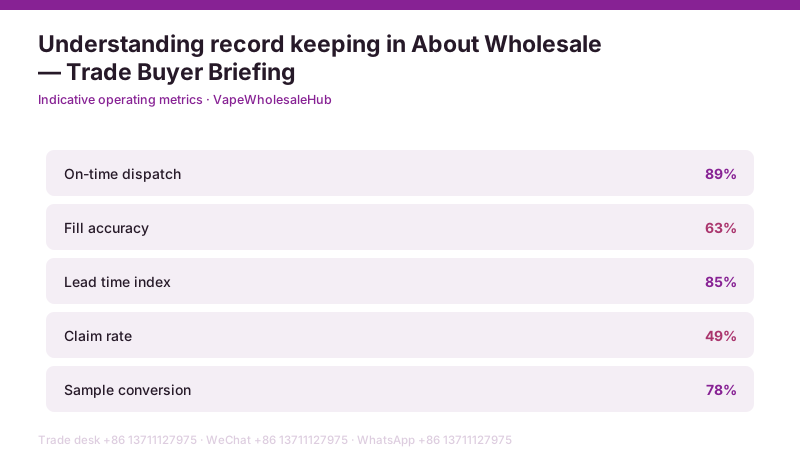
Where the supply actually comes from
On the sourcing side, understanding record keeping in About Wholesale — Trade Buyer Briefing comes down to how much of the chain you can see. A trading desk that only ever talks to a sales rep is buying on faith. We prefer accounts that ask for the factory audit, the mixing records and the batch numbers, because that paperwork is what protects everyone when a shipment is questioned later.
Sourcing decisions around understanding record keeping in About Wholesale — Trade Buyer Briefing are usually made on price and then regretted on consistency. The input changes, the tolerance drifts, and suddenly the line that sold through in March behaves differently in July. Locking the input specification in writing is the cheapest insurance a wholesale buyer can buy.
Technical detail worth understanding
The engineering around understanding record keeping in About Wholesale — Trade Buyer Briefing is mostly about managing heat and airflow. Change either and the whole experience moves. Buyers who understand that relationship can read a spec sheet properly and spot the marketing numbers that do not survive contact with a customer.
Specification drift is the quiet risk in understanding record keeping in About Wholesale — Trade Buyer Briefing. A unit approved in January is not necessarily the unit shipped in September unless the change control is tight. We document every revision, and we tell accounts before the change rather than after someone notices.
Order structure at a glance
| Item | Standard | Volume | Programme |
|---|---|---|---|
| Typical order unit | Master carton | Pallet | Full container |
| Documentation | COA + SDS | COA + SDS + batch record | Full technical file |
| Lead time | 2-4 working days | 5-10 working days | 15-25 working days |
| Customisation | Label only | Label + closure + bottle | Full OEM / ODM |
| Sampling | Charged, credited on order | Included in development | Multi-round approval |
| Indicative MOQ | 1000 units | 5,000 units | 20,000 units |
| Development window | n/a | 5-8 working days | 5-8 + approval |
Common questions
What is the usual minimum order quantity?
Minimum order quantity depends on the line. Standard stock items typically start at a single master carton, while custom work, private label artwork and bespoke tooling carry higher thresholds because the setup cost has to be recovered. We publish the figure for each line rather than quoting one blanket number.
What shelf life should we plan around?
Unopened e-liquid is typically stable for around two years when stored cool and away from direct light, and device batteries lose capacity on a similar curve. We print manufacture dates and batch codes on every unit so stock rotation is straightforward.
Which payment methods do you accept?
We accept bank wire transfer for most wholesale accounts, with card and digital payment options available for samples and smaller orders. Established accounts can apply for credit terms after a trading history has been established.
Related reading
- How About Drives Basket Size — New Account Setup
- About Vape Supply Notes 801
- How About Affects Cash Conversion Cycle — Multi Site Operations
- About: Evaluating Total Cost of Ownership — Contract Supply Guide
- About Vape Supply Notes 577
- About Vape Supply Notes 124
Talk to the wholesale desk. Specifications, MOQ, stock and freight options for understanding record keeping in About Wholesale — Trade Buyer Briefing.
Phone +86 13711127975 · WeChat +86 13711127975 · WhatsApp +86 13711127975